Instant digital download. One-time payment of $37. 40 hand-powered projects for kids 5 to 12.
Tinker Table Lab
Build working cardboard machines together at your kitchen table
40 step-by-step engineering projects for kids 5 to 12, each with age, time and a clear grown-up help level. Hand-powered, no batteries.
Kid can do itGrown-up nearbyGrown-up does this step
$37 one time. No kit to buy: every project is built from household recycling plus simple craft supplies.
Instant access
114-page printable PDF
Works on phone, tablet or computer
One-time payment
114-page PDF: one download, yours to keep
Any device: phone, tablet or computer
Made to print: US Letter pages, print only what you need
4 building chapters: structures, robots, vehicles and machines
Sound familiar?
"I want to do something hands-on with my kid, but I never know where to start."
"Half the project ideas I find need a special trip to the craft store."
"Every time I help, I end up building the whole thing myself."
"I'm not sure which steps are safe for my 6-year-old and which ones are mine."
"We have a mountain of shipping boxes and no plan for them."
"The video made it look easy. Ours fell apart and nobody knew why."
"My kid keeps asking how things work, and I run out of answers."
None of this means you are doing it wrong. Most project ideas skip the parts that matter at a real kitchen table: who holds the knife, how long it really takes, what to do when it collapses, and why it worked when it finally does. 40 Cardboard Engineering Projects puts all of that on the page, so you can spend the afternoon building instead of searching.
The real cost of winging it
It is Saturday morning. Your child wants to build something, so you search for ideas. Ten minutes later you have a project that needs a glue you do not own, a part you have never heard of, and an age range nobody mentioned.
If you spend twenty minutes searching for every project, a month of weekend builds costs you hours of scrolling before anyone touches a box. If the steps do not say which parts need a grown-up, you either hover over every cut or find out too late that a step needed a blade.
And if the build falls apart with no explanation, the lesson your child takes away is "I'm bad at this," not "now I know where the weak spot is."
Winging it costs you time, patience and a little of your child's confidence. A clear plan costs you one download.
Build it, test it, make it better
Every project in the book runs on the same simple loop. Kids learn the rhythm after one or two builds, and you always know what comes next.
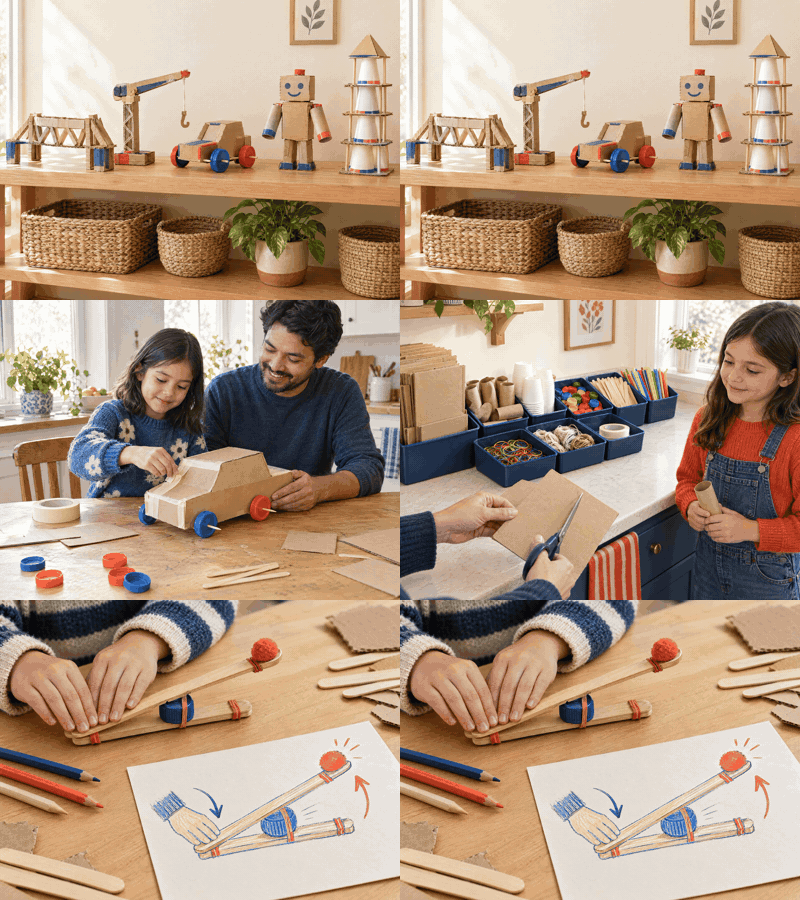
Every project ends with a test. A "Test it" step turns a craft into an experiment: count the books the bridge holds, measure how far the car rolls, then change one thing and try again.
You always know your role. Each project shows one of three help levels, and any step with a blade, hot glue or a sharp point is marked "Grown-up does this step". Your child does the rest.
The science comes after the fun. A short "What's happening" section explains each build in plain words: compression, tension, levers, pulleys, friction and more.
There is always a next round. A "Make it better" challenge at the end of each project gives your child a reason to go around the loop again, which is exactly how engineers work.
Count the books the bridge holds. Change one thing. Try again.
From download to first test in one afternoon
1. Download the book. Your PDF is ready right after checkout, on the thank-you page and in your email. Open it on a tablet at the table or print the pages you need.
2. Pick a project that fits today. Every project lists ages, time and help level at the top, so you can choose a 20-minute build or a longer afternoon project in seconds.
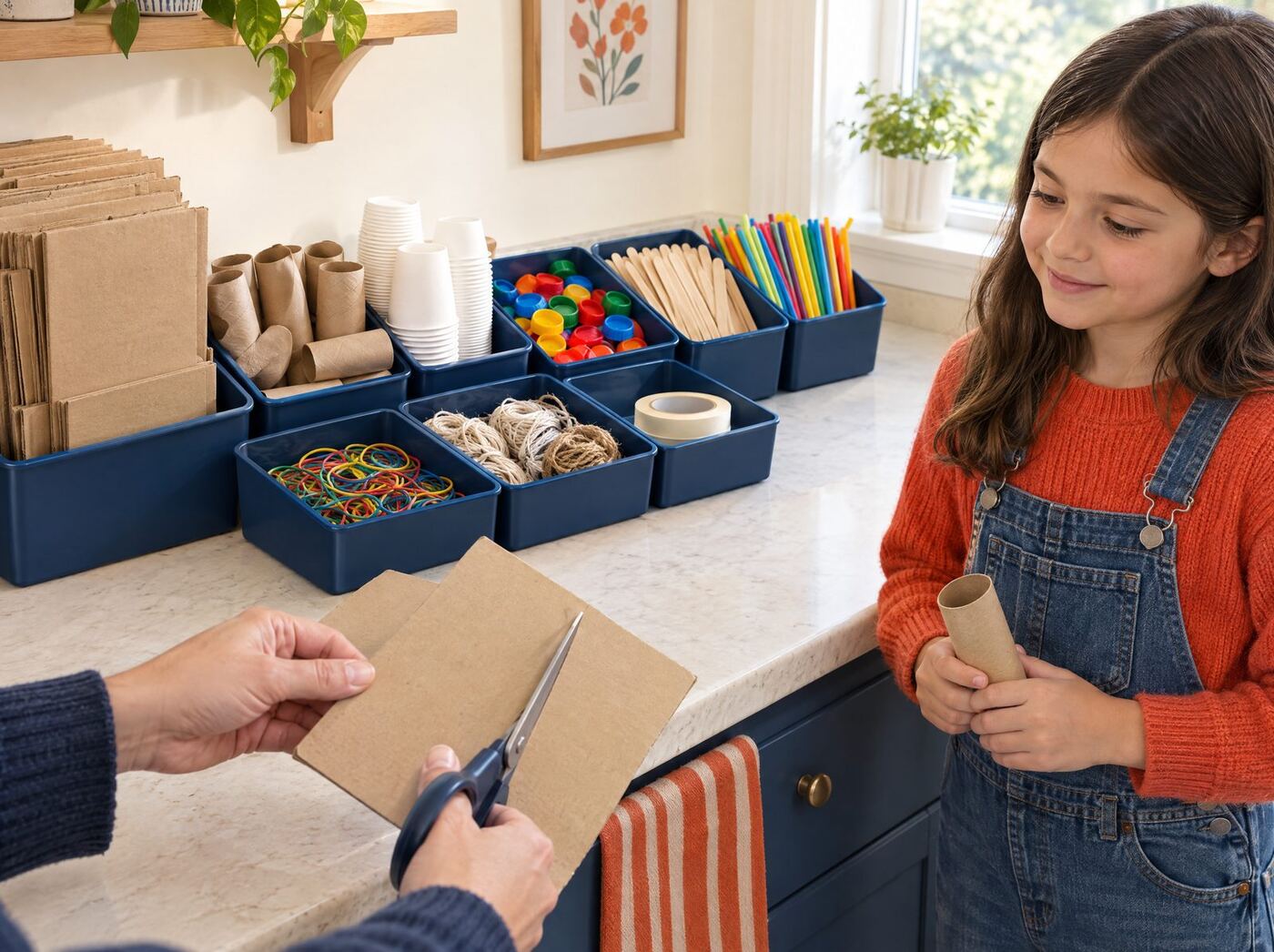
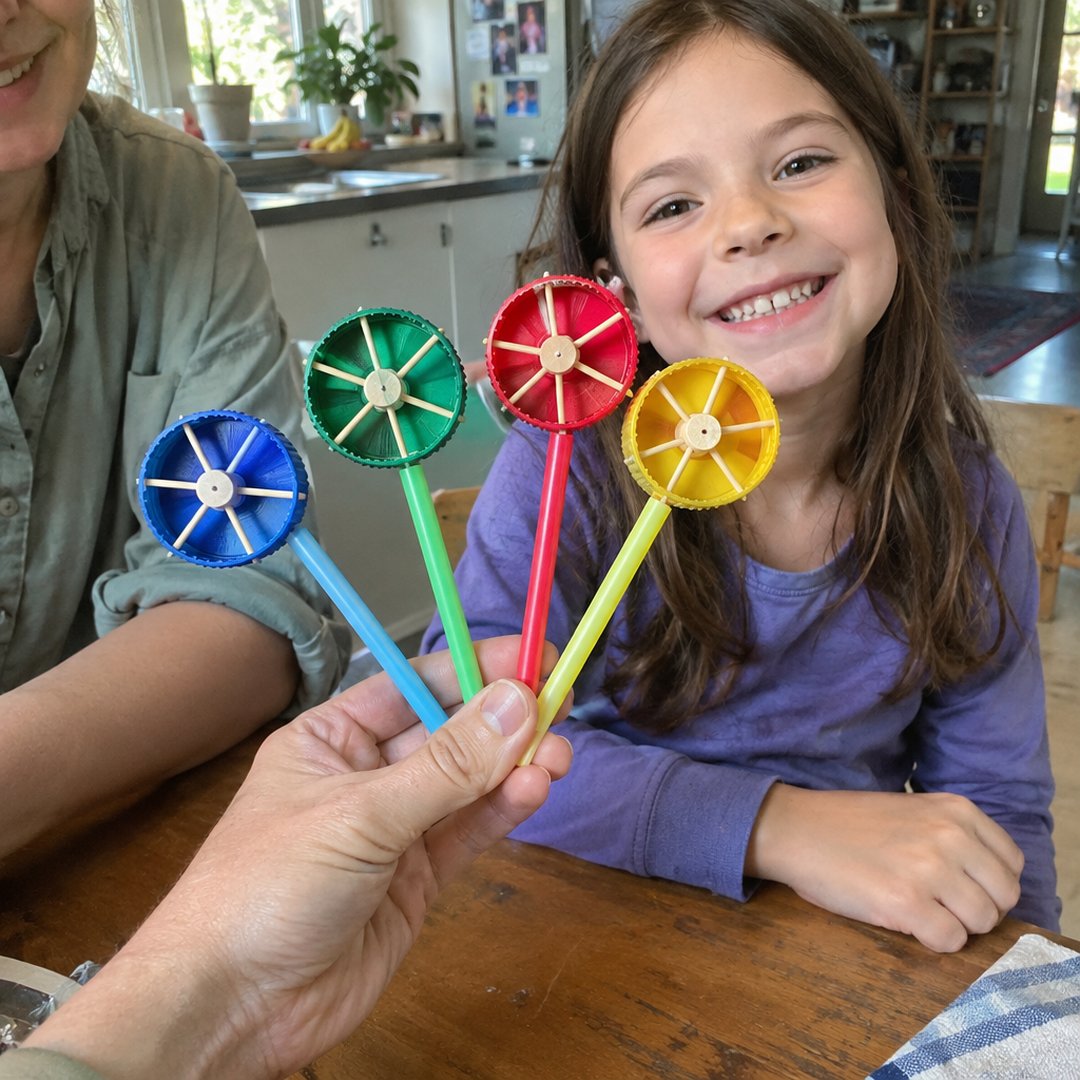
3. Raid the recycling. Gather the "You need" list: mostly shipping boxes, cereal boxes, paper tubes, cups and bottle caps, plus simple craft supplies.
4. Build, test, make it better. Follow the numbered steps, run the test, read "What's happening" together, then try a "Make it better" challenge.
What's inside the 114 pages
Here is everything in 40 Cardboard Engineering Projects, part by part, with where it sits in the book.
40 step-by-step projects in 4 chapters (pages 16 to 99).
Strong Structures, Moving Creatures & Robots, Rolling Vehicles, and Machines & Mechanisms: bridges, grabbers, wind-up cars, cranes and a marble run your child builds and tests. Each chapter has 10 projects and opens with the big idea behind it.
The Grown-Up Guide (pages 4 to 6).
The three help levels, how to help without taking over, questions to ask instead of giving answers, how to handle a build that falls apart, and what success really looks like.
Workshop Safety Rules and Materials Station (pages 7 to 13).
Clear rules for blades, hot glue, skewers, string, launchers and water projects, a printable rules checklist to read together, plus what to save, what to buy, which tools are grown-up only and five cardboard skills to learn.
Invent Your Own, plus keepsakes (pages 100 to 112).
Six inventing steps, three open challenges and a My Invention Plan page, then a Certificate of Inventing page and a 42-word glossary for young engineers.
The Inventor Loop (pages 14 and 15).
Imagine, Build, Test, Improve: the four-step loop every project follows, with a test record page for writing down what changed and what happened.
The same six parts in every project.
Ages, Time and Help level at the top, then You need, Build it, Test it, What's happening and Make it better, so younger builders learn the rhythm fast.
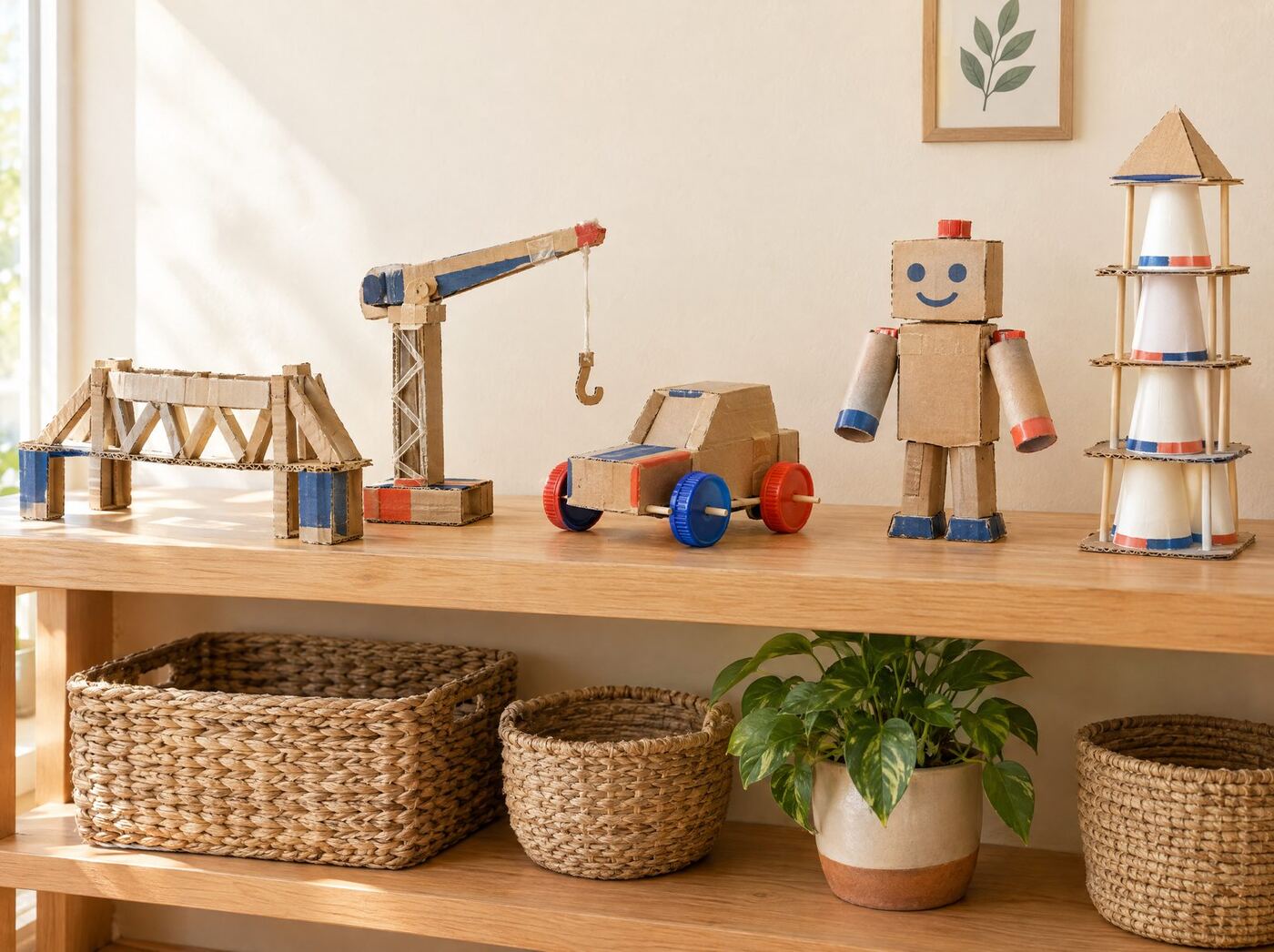
Chapter 1, Strong Structures: towers, a truss bridge, an arch bridge, a suspension bridge, a dome and a stool that holds books.
Chapter 2, Moving Creatures & Robots: a chomping crocodile grabber, a robot hand with straw tendons, a walking penguin and a hydraulic robot arm that lifts with water.
Chapter 3, Rolling Vehicles: a wheel and axle workshop, ramp racers, a rubber-band wind-up car, a crank cart and a zip line rider.
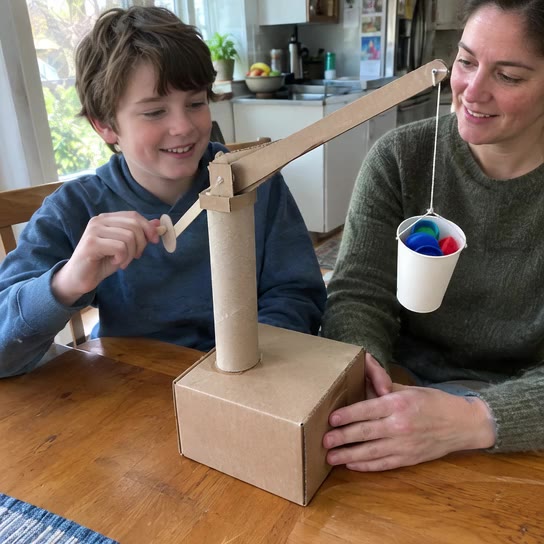
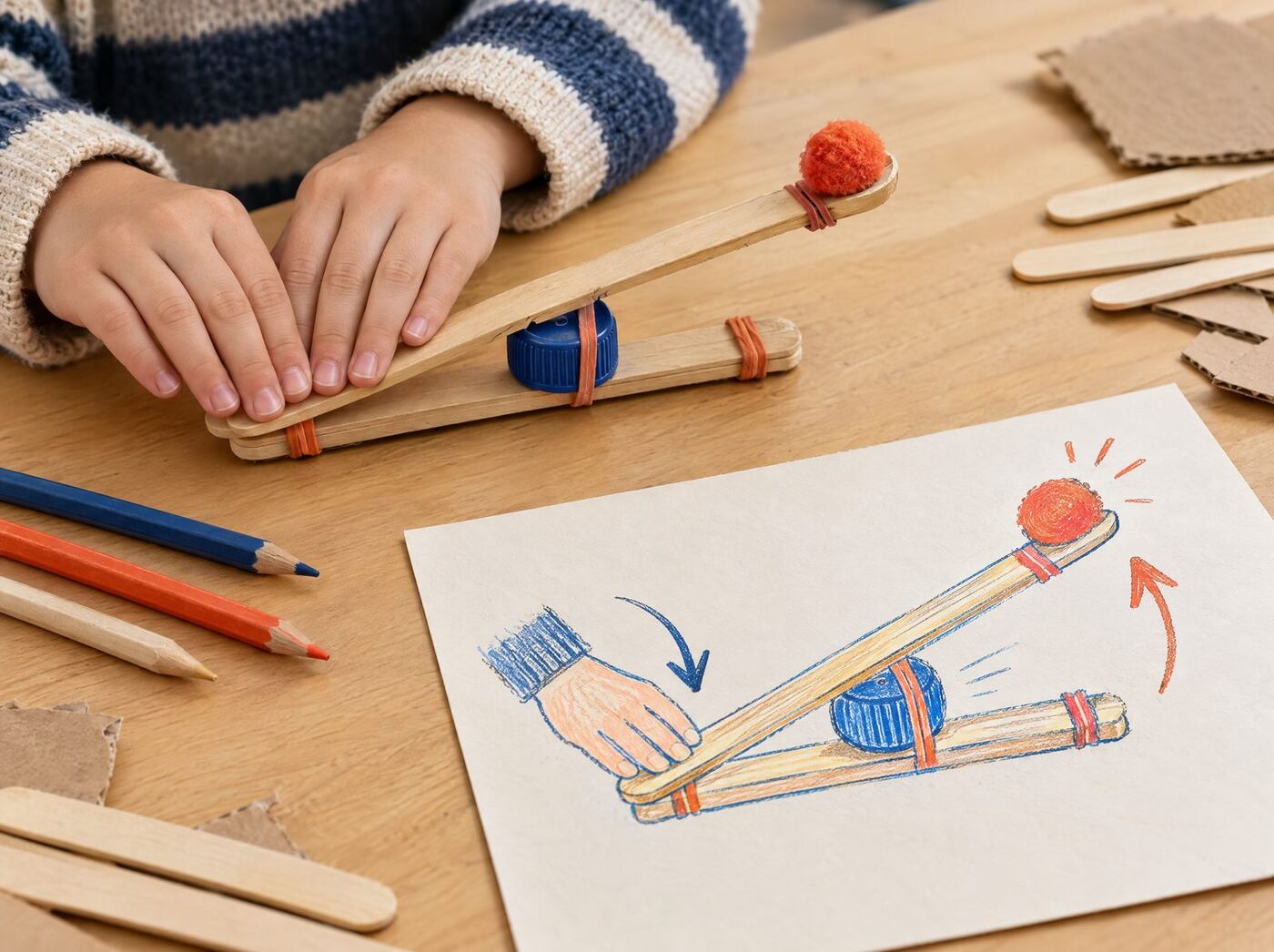
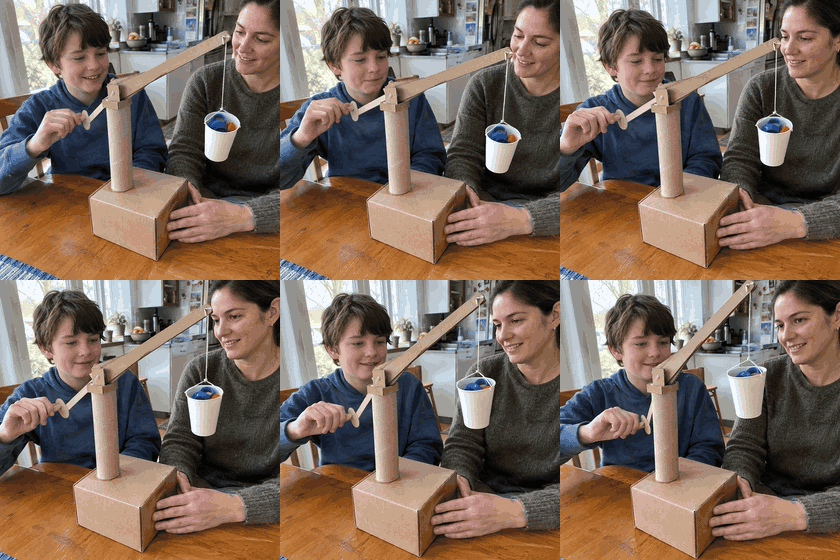
Chapter 4, Machines & Mechanisms: a lever lifter, a pulley elevator, a crane with a winch, a pom-pom catapult, a wall marble run and a castle drawbridge.
Project times run from 20 to 90 minutes, and 33 of the 40 projects take an hour or less. 10 projects are "Kid can do it", 7 are "Grown-up nearby" and 23 have at least one "Grown-up does this step".
A Saturday at the tinker table
After breakfast, you open the book on a tablet and let your child flip through the chapters. They stop at the Ramp Racers. The top of the page says ages 5 to 12, a time estimate and the help level, so you know in a few seconds that this one fits before lunch.
Your child reads out the "You need" list while you check the recycling bin. A shipping box, some bottle caps, wooden skewers with the points already snipped off by you, a few straws and tape. No trip to the store.
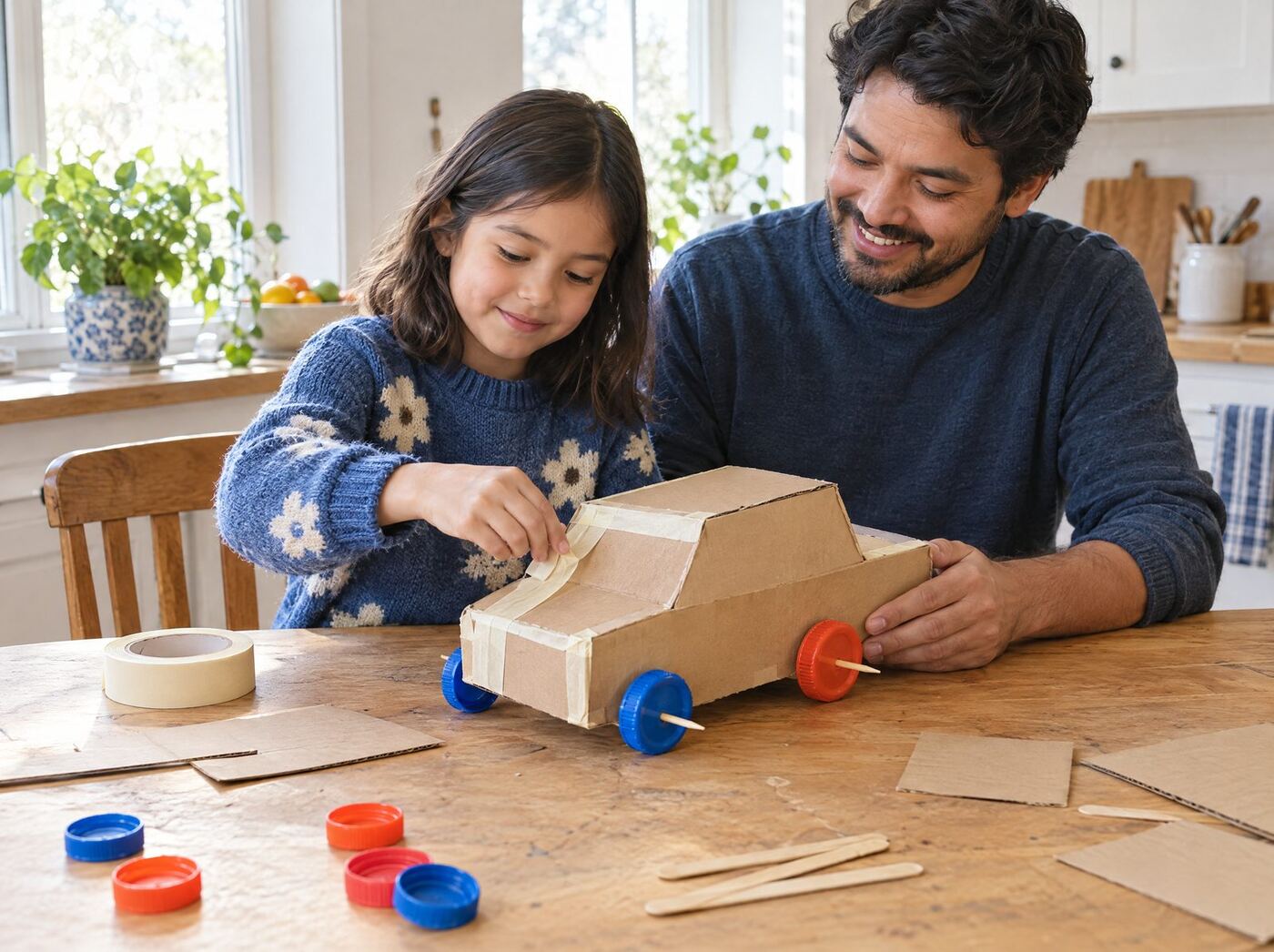
The build takes shape on the kitchen table. When a step needs a grown-up, it says so, and you take that step. Everything else stays in your child's hands, even when the wheels wobble and you would love to fix them yourself.
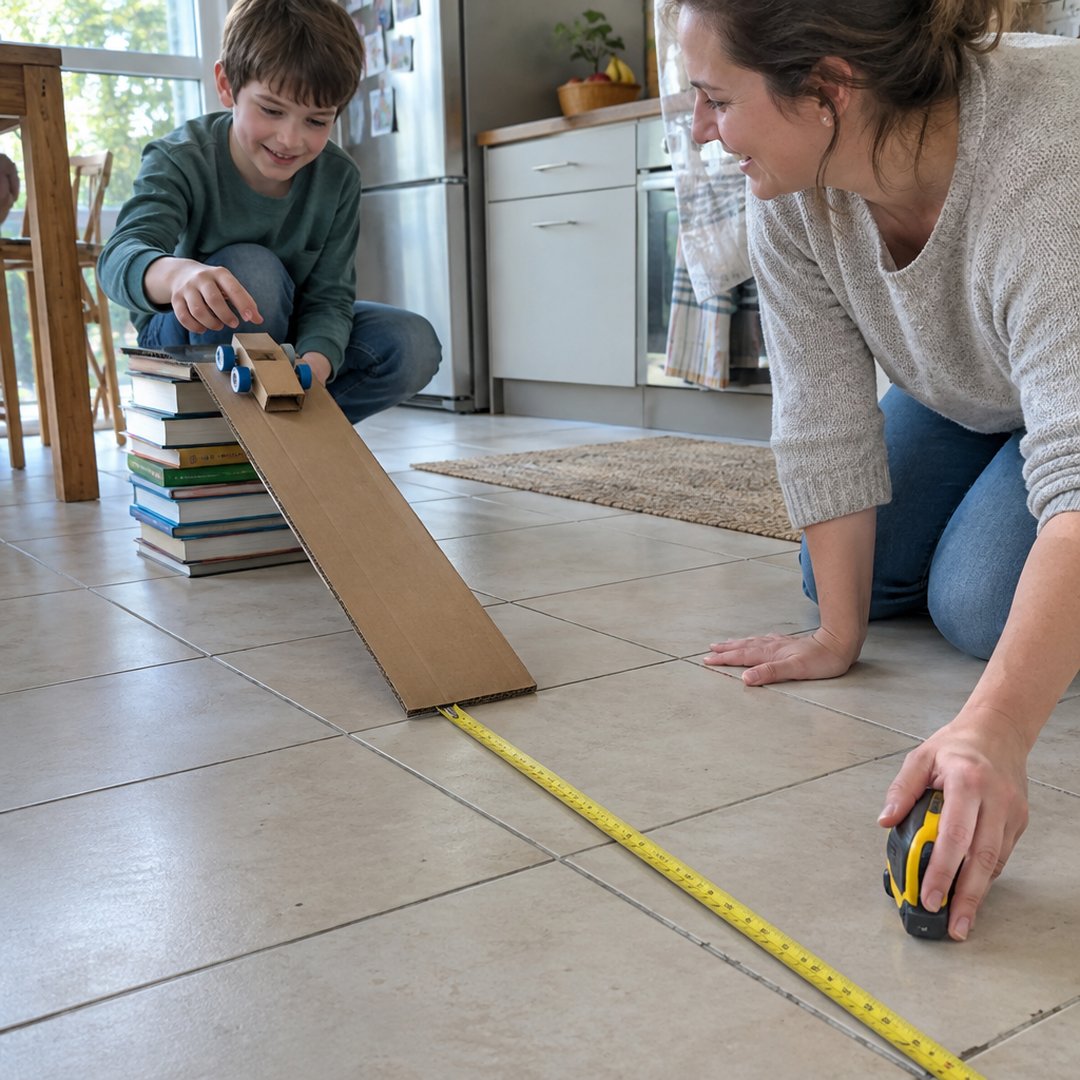
Then comes the test. A stack of books becomes a ramp, a tape measure comes out, and the first car rolls a short way and stops. Your child reads "What's happening" and finds out why. They change one thing, try again, and the car goes farther. You hear "Again!" more times than you can count.
By the afternoon, the car sits on the display shelf, and your child is already asking what to build tomorrow.
Who it is for
Parents, grandparents and caregivers of kids aged 5 to 12 who want a hands-on project to do together
Kids who ask "how does that work?" and love taking things apart
Families with a stack of shipping boxes, paper tubes and bottle caps waiting to be used
Grown-ups who want clear steps and want to know exactly which parts are theirs
Homeschool families and weekend builders looking for ready-to-go projects
Who it is not for
Families looking for electronic robotics with motors, batteries, sensors or coding
Anyone expecting a physical kit in the mail: this is a digital download
Children building with blades or hot glue on their own: an adult handles those steps
Anyone looking for a school curriculum or a way to raise test scores
Grown-ups who want a finished model without the testing and trying again
Three ways to spend a building afternoon
Comparison
Starting from scratch
Free videos and scattered posts
40 Cardboard Engineering Projects
Structure
You invent every step yourself
Different format and level every time
The same six-part layout in all 40 projects
Time to start
Planning before every build
Searching and checking before every build
Pick a project by age, time and help level
Grown-up help level
You guess which steps are yours
Rarely stated
Marked on every project and every grown-up step
Printable
Only what you write down
Usually not
US Letter pages, plus checklists and plan pages
Covers the science
Only if you look it up
Sometimes
"What's happening" in every project
Cost
Free, plus your time
Free, plus your time
$37 one time
Free ideas can be great. The difference here is that everything is in one place, in one consistent format, with the safety steps already sorted.
Your next rainy afternoon, already planned
40 projects, one box of recycling, and a kid who gets to say "I built that."
Want even more to build?
These are optional. You can add any of them in the next step, or all three as the Complete Bundle for $22 (save $29).
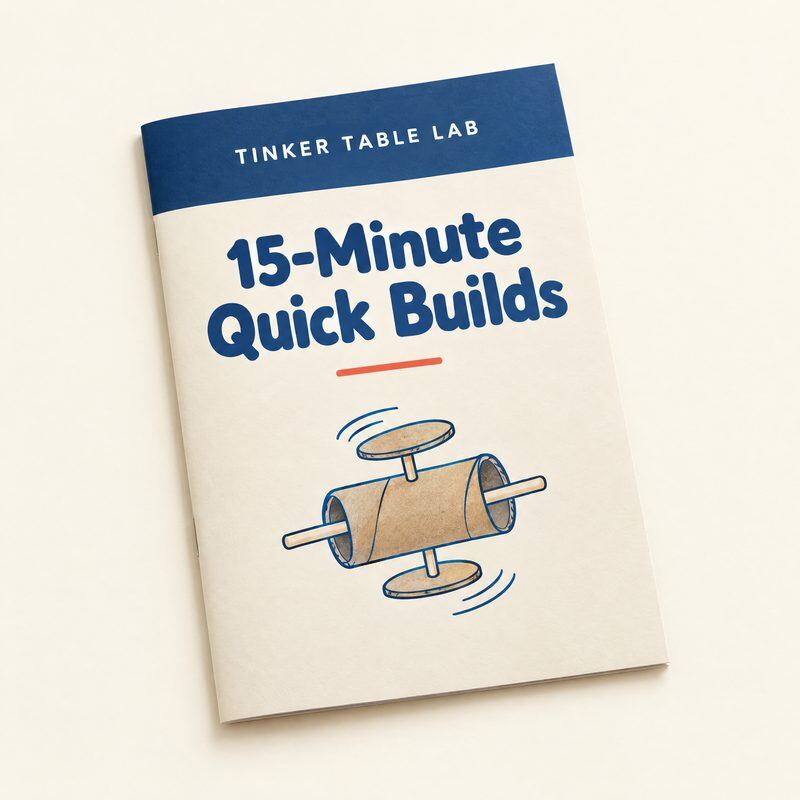
15-Minute Quick Builds.
For the days you have fifteen minutes, not an afternoon. 25 builds of about 15 minutes each across five chapters: Stand It Up, Make It Move, Make It Roll, Make It Fly and Make a Sound. Each lists ages and help level. 31-page PDF.
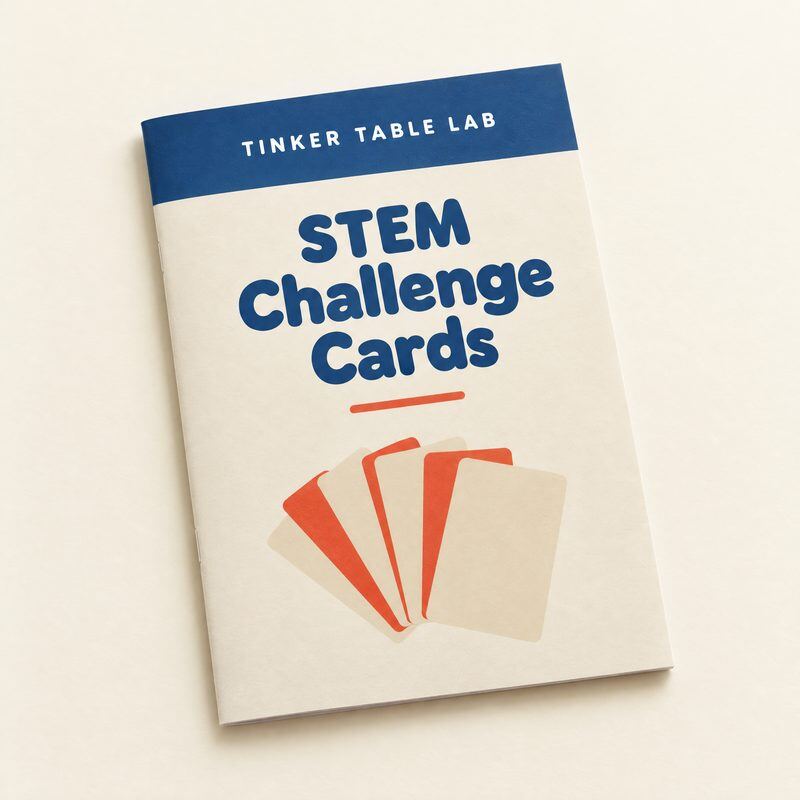
STEM Challenge Cards.
Pick a card, set a timer, build and test. 48 challenge cards in four families of 12: Build It Tall, Carry the Load, Move It and Protect It, each with a goal, materials, rules and a twist, plus a score sheet and kid-friendly science notes. 34-page PDF.
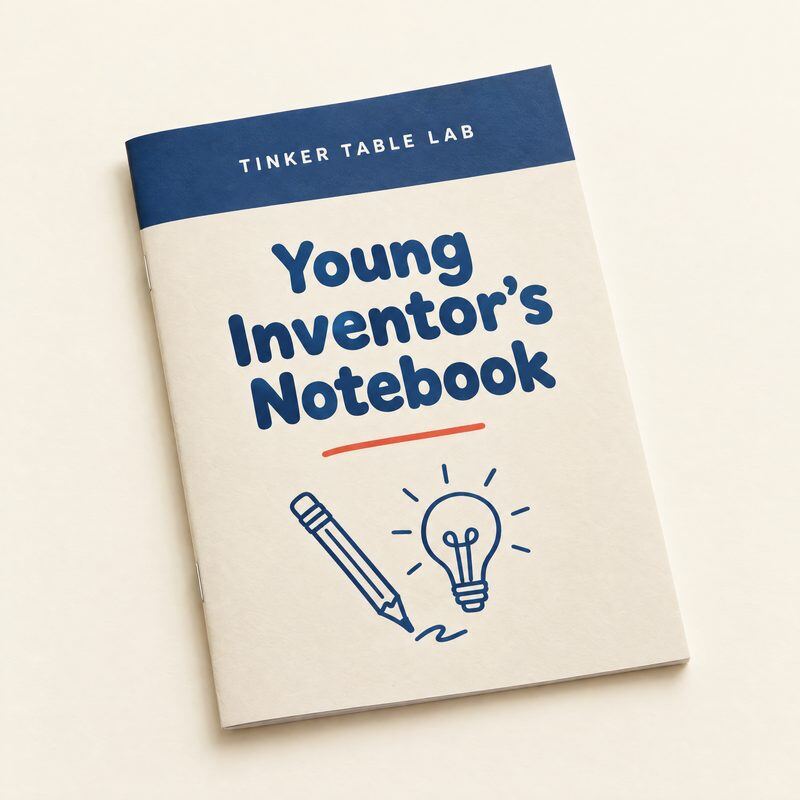
Young Inventor's Notebook.
A place for your child to sketch, test and track every invention. 12 Invention Logs with an idea, sketch area, materials checklist, build notes and a test results table, plus 20 inventor badges, Big Ideas pages and a My Best Invention page. 51-page PDF.
Added in the next step, or all three as the Complete Bundle for $22 (save $29).
Everything you get
40 step-by-step projects: structures, moving creatures, rolling vehicles and machines, each with ages, time and help level
Test it, What's happening, Make it better: in every one of the 40 projects
The Grown-Up Guide: how to help without taking over, and questions to ask instead of giving answers
Workshop Safety Rules: with a printable rules checklist to read together
Materials Station guide: what to save, what to buy and which tools are grown-up only
The Inventor Loop and test record page: imagine, build, test, improve
Invent Your Own chapter: six inventing steps, three open challenges and a plan page
Certificate of Inventing page and 42-word glossary: a keepsake and the words engineers use
Today: $37, one-time
Pay with card, Apple Pay or Google Pay. Secure checkout by Stripe.
14 days to build with it
Download the book, gather some boxes and try a few projects with your child. If it is not right for your family, email productadvice.info@gmail.com within 14 days of purchase with your order email, and we will refund your $37 for 40 Cardboard Engineering Projects. No forms and no questions to fill in, just a short email. The refund goes back to your original payment method.
How we made this book
40 Cardboard Engineering Projects is written for parents and caregivers building with children aged 5 to 12. Every project was written to be built from household recycling and simple craft supplies, with the grown-up steps marked in the text.
The science explanations follow public educational sources, including NASA educator materials on simple machines and NASA Glenn Research Center pages on motion and center of gravity, Science Buddies guides to the engineering design process, TeachEngineering lessons on levers, pulleys and ramps, and Encyclopaedia Britannica entries on bridges, levers, cams and friction.
The safety rules follow guidance from the U.S. Consumer Product Safety Commission on button batteries, magnets and small parts, and from the National Capital Poison Center on battery ingestion. That is why the book has no batteries, no magnets and no balloons, and why every blade, hot glue and sharp point step belongs to a grown-up.
Every source is listed by name and link at the end of the book, so you can read more on any topic.
Building safely together
The projects are for children aged 5 to 12 building with an adult. Grown-ups do all blade cutting, hot glue (low-temperature glue gun only), hole poking and skewer snipping.
No project uses batteries, motors or magnets. Keep button and coin batteries and small magnets out of the workshop and out of reach of children.
Some builds use small parts like bottle caps, paper fasteners and marbles. Keep them away from children under 3, including younger brothers and sisters.
Launchers use soft ammo only, such as pom-poms or paper balls, and are never aimed at people or pets. Strings and rubber bands never go around anyone's neck.
If you think a child has swallowed a button battery, a magnet or something harmful, get medical help right away. In the US, call Poison Help at 1-800-222-1222, the National Battery Ingestion Hotline at 1-800-498-8666, or 911 in an emergency.
This book is educational content for families, not professional safety advice. You are the best judge of what your child is ready for.
FAQ
What exactly do I get?
A 114-page PDF, 40 Cardboard Engineering Projects, in US Letter size. It includes the Grown-Up Guide, the Workshop Safety Rules, the Materials Station guide, the Inventor Loop, 40 projects in 4 chapters, the Invent Your Own chapter, a Certificate of Inventing page and a glossary.
How do I get it?
Right after payment, your download buttons appear on the thank-you page. We also email you personal links that stay active for 7 days. If they expire, get fresh links anytime at /access with your purchase email.
I can't find the email. What should I do?
Check your spam or promotions folder first. If it is not there, go to /access, enter the email you used at checkout, and we will send fresh links. You can also email productadvice.info@gmail.com.
What devices does it work on?
Any phone, tablet or computer that opens a PDF. You can keep it open on a tablet at the table while you build.
Do I need to print it?
No, but you can. Print the whole book, or only the pages you need, such as the workshop rules checklist, a project, the My Invention Plan page or the Certificate of Inventing page.
How long does each project take?
Each project lists its own time, from 20 to 90 minutes. 33 of the 40 projects take an hour or less. Half-finished builds can wait on a shelf until tomorrow.
My child is 5 and can't read yet. Will this work?
Yes, with you reading the steps out loud. Every project lists an age range, and the book suggests that kids aged 5 to 7 get more help with reading and fiddly parts, while kids aged 8 to 12 can often read a project on their own.
Is it too easy for a 12-year-old?
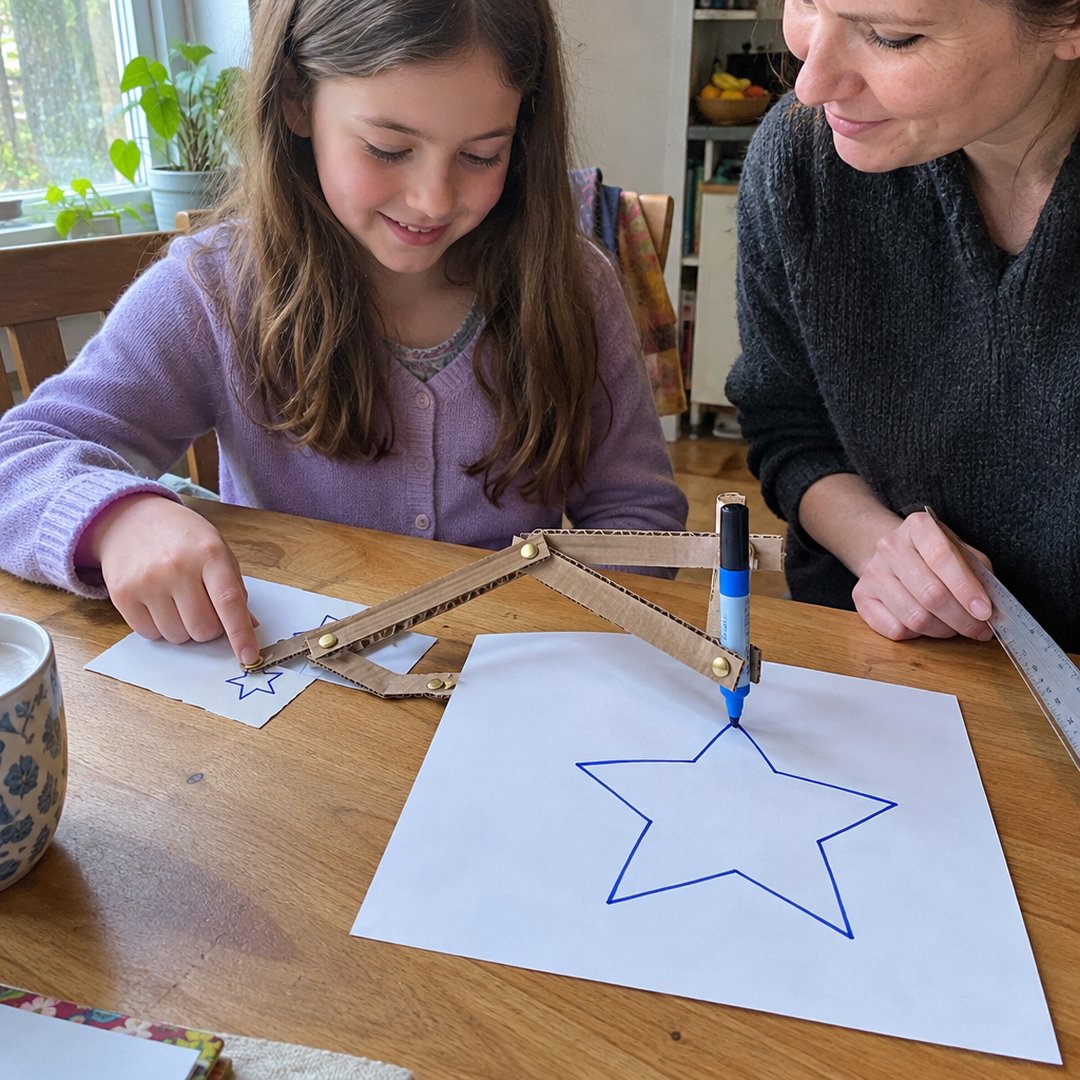
Older kids can pick the projects marked for ages 8 to 12, such as the hydraulic robot arm, the walking penguin linkage or the copycat drawing machine, then push further with the "Make it better" challenges and the three open challenges in Invent Your Own.
What materials do we need?
Mostly recycling: shipping boxes, cereal boxes, paper tubes, paper cups and bottle caps. Add inexpensive craft supplies such as craft sticks, wooden skewers, straws, paper fasteners, rubber bands, string, tape and glue. One project uses needle-free plastic syringes and clear tubing.
Do I need special tools?
Kids use scissors suited to their age, a ruler, a pencil and tape. Grown-ups need a craft knife or box cutter with a cutting mat, a low-temperature glue gun and strong scissors or pruners for snipping skewer points. The Materials Station chapter lists who uses each tool.
Is it safe for kids?
The book is for children aged 5 to 12 building with an adult. Grown-ups do all blade cutting, hot glue (low-temperature glue gun only), hole poking and skewer snipping. No project uses batteries, motors or magnets. Some builds use small parts like bottle caps, so keep them away from children under 3. The book is educational content for families, not professional safety advice, and you are the best judge of what your child is ready for.
Is this a robotics kit?
No. The robots and machines in this book are made from cardboard and powered by hands, rubber bands, string or water. There are no motors, batteries, electronics or coding.
Can I use it with more than one child?
Yes. Your purchase is for use by you and your household, so siblings can build from the same book, side by side or taking turns on the same project.
Does it work for homeschooling?
Yes, as hands-on projects alongside your lessons. The book is not a school curriculum and does not follow any state standards, but every project explains its science in plain words.
What are the add-ons?
Three optional extras: 15-Minute Quick Builds, STEM Challenge Cards and the Young Inventor's Notebook, $17 each. You can add any of them in the next step, or all three as the Complete Bundle for $22.
Is this a subscription?
No. You pay once and the files are yours to download and keep. There are no recurring charges.
What if it's not right for us?
Your purchase of 40 Cardboard Engineering Projects is covered by a 14-day money-back guarantee. Email productadvice.info@gmail.com with your order email.
Is this professional advice?
No. It is educational content for families. It is not professional safety, medical or teaching advice, and it does not promise any learning or developmental outcome.
Turn the box pile into a workshop
One download, 40 projects, and a tinker table that is ready whenever your child is.